
The Baghdad Library · Essay 1
The astrologers of Abbasid Baghdad, and where their art came from
About 9 minutes to read
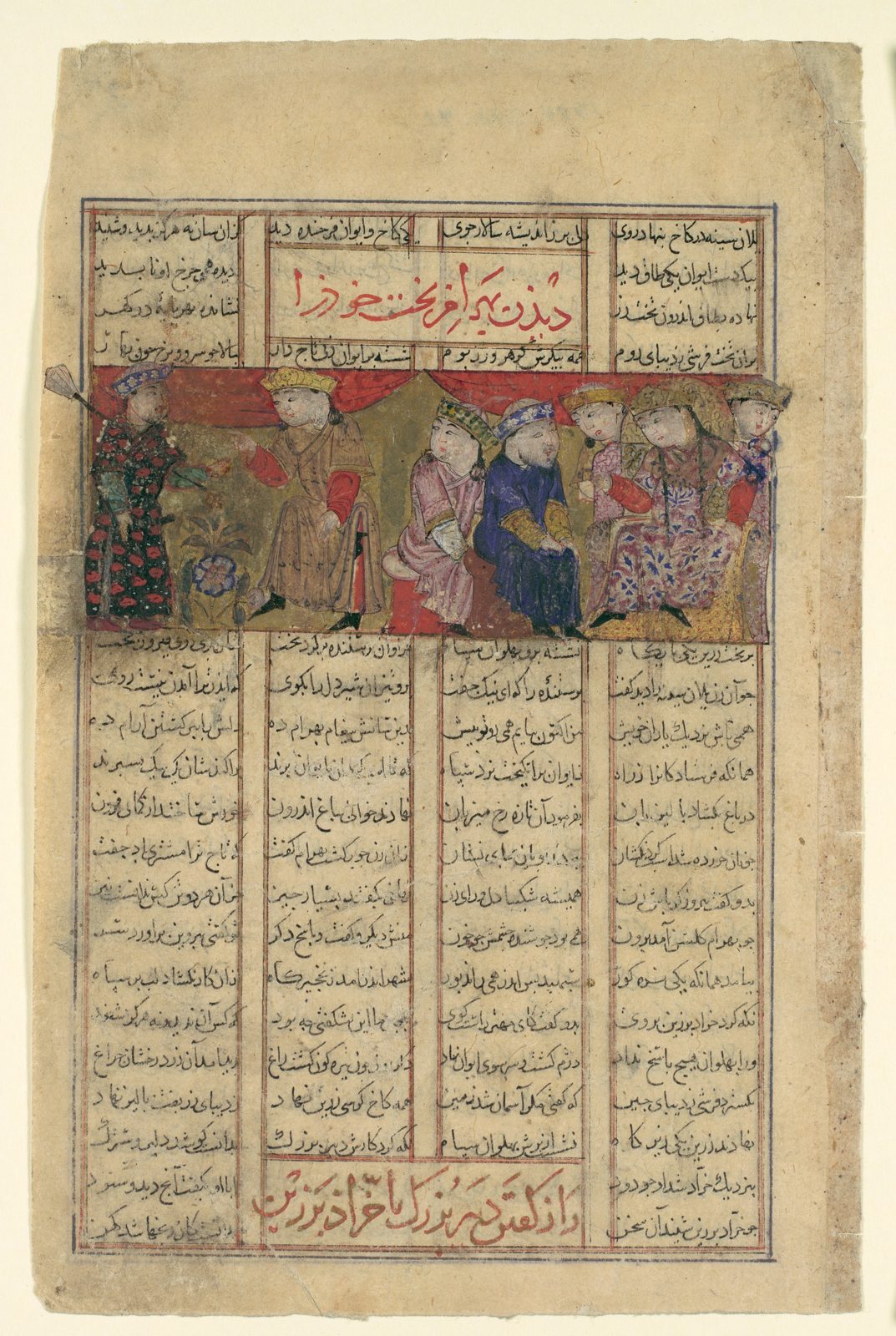
In the summer of 762, the caliph al-Manṣūr wanted to build a new capital on the Tigris. Before the first bricks were laid, he asked his astrologers to choose the moment. According to the scholar al-Bīrūnī, writing nearly 250 years later, the Persian astrologer Nawbakht cast the chart for the founding of Baghdad, and building began on the day he chose, at the end of July 762. Other early historians name more court astrologers who worked alongside him: al-Fazārī; ʿUmar al-Ṭabarī, a Persian from Tabaristan; and Māshāʾallāh, a Jewish astrologer from Basra.
Whatever one thinks of the stars, the hour they chose served the city well. Within a generation, Baghdad was one of the largest cities on earth, and the capital of a state that reached from North Africa to Central Asia. Under the Abbasids, paper-making spread west from Baghdad, scholars translated the science of Greece, Persia and India into Arabic, and the city's libraries, hospitals and markets drew people from three continents. For the next five centuries, much of the world's new mathematics, medicine and astronomy was written in Arabic. It is easy to see why later writers told the story of the founding hour with such pride. To them, the rise of the round city showed that the astrologers had chosen well.
That story tells you most of what you need to know about astrology in the early Abbasid state. It was not a fairground trick. It sat at the centre of government, next to engineering and finance, and the people who practised it were among the best-read men of their age. They also came from everywhere. Persian, Jewish, Christian and Arab scholars working side by side for the caliph is not an exception in this story. It is the rule.
Three rivers into one city
Abbasid astrology did not start in Baghdad. It arrived there, from at least three directions, and Baghdad was where the streams met.
From Persia
The Abbasids came to power in 750 with strong support from the eastern provinces of the old Persian empire. Under the Sasanian kings, astrology had been a court discipline, and Persian scholars translated Greek astrological works into Middle Persian, probably including the poem of Dorotheus of Sidon on birth charts. Persian astrologers also developed the idea that the meetings of Jupiter and Saturn, every twenty years or so, mark the rise and fall of dynasties and religions. When the new caliphs hired astrologers, many of them were Persians, or trained in the Persian tradition, and they brought these texts and ideas with them.
From India
A few years after Baghdad was founded, around 771 to 773, a scholar from India came to al-Manṣūr's court with a Sanskrit astronomical work. The caliph had it translated into Arabic, and the scholars al-Fazārī and Yaʿqūb ibn Ṭāriq turned it into astronomical tables. The result, known as the Zīj al-Sindhind, gave Baghdad's astronomers Indian methods for calculating the positions of the planets. Indian ideas also reached astrology, and centuries later al-Bīrūnī would travel to India and write a long, careful comparison of the two traditions.
From Greece
The deepest layer was Greek. Claudius Ptolemy, working in Roman Alexandria in the 2nd century, had written the Almagest on astronomy and the Tetrabiblos on astrology. Both were translated into Arabic, along with other Greek scientific works, in the great translation movement of the 8th to 10th centuries. Under the caliph al-Maʾmūn (reigned 813–833), the court supported this work and sponsored programmes of observation in Baghdad and near Damascus, around 828 to 832, to check the old tables against the sky.
The people
Māshāʾallāh ibn Atharī (c. 740–815) was a Jewish astrologer from Basra. His short, practical books on birth charts and on world events were later translated into Latin, and medieval Europe knew him as Messahala.
Theophilus of Edessa (died 785) was a Christian scholar who served the caliph al-Mahdī as an astrologer, including on military campaigns. He translated Greek works into Syriac and wrote on the astrology of war.
Sahl ibn Bishr, a 9th-century astrologer of Jewish origin, wrote clear handbooks on answering questions by the stars, which also passed into Latin.
Then there is Abū Maʿshar al-Balkhī (787–886), the most famous of them all. He came from Balkh, in today's Afghanistan, and settled in Baghdad. The 10th-century bookseller Ibn al-Nadīm tells us that Abū Maʿshar began as a scholar of religious tradition and only turned to astrology at forty-seven. He had stirred up feeling against the philosopher al-Kindī, and al-Kindī answered by drawing him into mathematics. Whatever the truth of that story, he became the great systematiser of the art. His Great Introduction was translated into Latin twice in the 12th century and shaped how Europe understood astrology for the next five hundred years.
What they actually did
These astrologers worked with three kinds of question. The first was the birth chart: what the sky at a person's birth said about their character and life. The second was timing, or "elections": choosing the right moment to found a city, crown a ruler or start a journey, as Nawbakht did for Baghdad. The third was the history of the world, read through the great conjunctions of Jupiter and Saturn and the yearly chart cast at the spring equinox.
Their tools were mathematical. They used tables of planetary positions, worked out which part of the sky was rising at a given moment, and applied a large set of rules about which planet "rules" which sign. They also used the 28 mansions of the Moon, an old Arabian way of dividing the Moon's path by the stars it passes each night. That last tool is the one we show you every evening on the front page.
Why this matters now
Modern popular astrology mostly descends from these men, through the Latin translations of the 12th century and the European astrologers who read them. But a great deal was lost along the way: the mansions of the Moon, the time lords that divide a life into periods, the careful rules about day and night births. Lazward goes back to the Baghdad sources and shows you which rule, from which book, sits behind every reading.
None of this asks you to believe that the stars decide your fate. Many of these scholars argued about exactly that question, and al-Bīrūnī himself was openly sceptical of parts of the art he taught. What they left us is a way of looking at the sky with attention and with reasons. That is worth having.
Sources and further reading
- Al-Bīrūnī, The Chronology of Ancient Nations, tr. C. E. Sachau (1879): on the founding horoscope of Baghdad.
- Ibn al-Nadīm, The Fihrist, tr. B. Dodge (1970): on Abū Maʿshar, Māshāʾallāh and the translators.
- D. Pingree, The Thousands of Abū Maʿshar (1968); and D. Pingree et al., "Astrology and Astronomy in Iran", Encyclopaedia Iranica.
- D. Gutas, Greek Thought, Arabic Culture: The Graeco-Arabic Translation Movement in Baghdad and Early ʿAbbāsid Society (1998).
- C. Burnett, K. Yamamoto and M. Yano (eds.), Abū Maʿshar, The Abbreviation of the Introduction to Astrology (1994).
Spotted an error? Write to hello@lazward.app and we will correct it, with a note on this page.